
A customer data platform (CDP) is software that collects customer data from across your systems, unifies it into a single profile per person, and makes that profile available to the tools you actually run campaigns in. That’s the simple version. The harder questions are the ones marketing teams get stuck on: do we genuinely need one, or is this a data hygiene problem in disguise? What’s the difference between a CDP and a CRM? Why do CDP costs vary from $50K to $250K a year for what looks like the same thing? And which of the seventeen vendors on the longlist actually fit our stack?
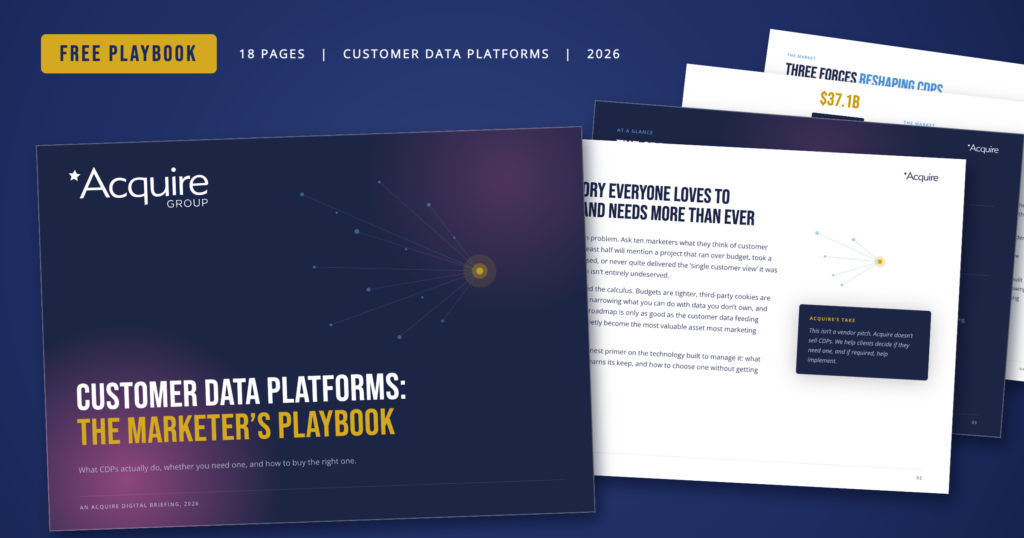
Customer Data Platforms: The Marketer’s Playbook is a free 17-page briefing that answers all of it; what CDPs do, when they earn their keep, what they really cost once usage fees and add-on modules land, and how to run a shortlist without getting sold to.
What is a customer data platform (CDP)?
A CDP is a system that collects customer data from multiple sources, resolves it into one unified profile per person, and makes those profiles available to other tools in real time or near real time. Unlike a data warehouse, it’s built to be used by marketers directly; segment building, activation, campaign triggers – without needing IT for every basic task.
What’s the difference between a CDP and a CRM?
A CRM manages known relationships; contacts, deals, service history etc and is usually operated by sales and service teams. A CDP unifies data about both known and anonymous customers from every source you have, including web behaviour, transactions and support tickets, and pushes it out to marketing channels. Many organisations run both; the CDP typically sits underneath, feeding the CRM rather than replacing it.
What’s the difference between a CDP and a DMP?
A DMP handles anonymous, third-party audience data for ad targeting, usually on short cookie-based windows. A CDP handles first-party, identifiable customer data with persistent profiles. As third-party cookies have disappeared, the DMP model has narrowed considerably while the CDP model has become core infrastructure.
Do I actually need a CDP?
You likely have a case if you lack one trusted system of record for customer profiles, your data is scattered in ways that block activation, you regularly lose time to manual cleanup and deduplication, and you’ve identified specific cross-channel use cases your current tools can’t support. If only one or two of those apply, the fix is usually better data hygiene rather than a new platform. The playbook includes a seven-point gut check to run before you take a vendor call.
How much does a CDP cost?
Enterprise CDP deals typically fall in the $50,000 to $250,000 range per year, though that figure is a starting point rather than a total. Most contracts blend three things: a base subscription for core unification and segmentation, usage-based fees tied to events, profiles or compute, and add-on modules such as advanced analytics, clean rooms or generative AI priced separately. Teams with seasonal traffic spikes should ask any shortlisted vendor to model their actual usage, not average usage, before signing.
What are the different types of CDP?
There are four. Data CDPs collect, unify and store data into exportable segments. Analytics CDPs add modelling, prediction and journey mapping. Campaign CDPs focus on orchestrating one-to-one treatments across channels. Delivery CDPs actually send the message; email, app, web, CRM etc and are the fastest-growing type in the category, projected at around 31.7% annual growth. Knowing which type you’re evaluating stops you comparing platforms that were never built to do the same job.
What is a composable or warehouse-native CDP?
A composable CDP runs directly on top of your existing cloud data warehouse: Snowflake or Databricks, typically – rather than holding a separate copy of your customer data. It reduces duplication, simplifies governance and audit, and uses your warehouse’s own logic instead of a proprietary identity graph. Adoption is growing quickly, but composable models still account for under 5% of category deployment, so it’s a real shift rather than the mainstream default.
Which CDP is best?
Honestly, there isn’t one. The right platform depends on the stack you already run. Salesforce Data Cloud suits organisations with Salesforce as their CRM backbone; Adobe Real-Time CDP fits large omnichannel enterprises already on Adobe; Tealium and Twilio Segment prioritise vendor neutrality; Zeotap is built for paid-media match rates. The playbook maps 17 vendors by model, best fit, standout strength and pricing signal so you can build a longlist in one sitting.
How do you choose a CDP?
Four steps, in order. Confirm the need and baseline your KPIs before talking to any vendor. Shortlist with discipline by mapping must-have integrations, then narrowing to three or four finalists judged on identical criteria. Demo on your own data and scenarios, not a rehearsed script. Then check references before you negotiate; references reveal what the sales cycle won’t, and that’s leverage on pricing and SLAs.